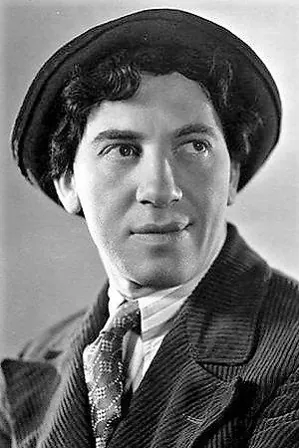
Chico Marx, born in 1887, was a pivotal figure in American comedy as part of the Marx Brothers. His role in The Story of Mankind (1957) highlights his signature persona as a bumbling con artist, a character that resonated with audiences and contributed to the film's cult status. Known for his distinctive appearance and comedic timing, Chico's performances brought a unique flair to the genre of comedy, making him an enduring presence in the annals of cult cinema.
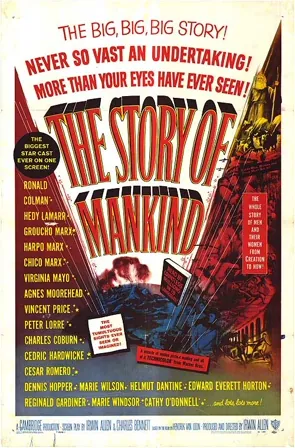
The Story of Mankind
Two angels, appearing as stars in the heavens, discuss how man has invented the super H-bomb sixty years ahead of schedule. Noting that all of mankind will be destroyed if the bomb is detonated, the stars report the news to the High Tribunal of Outer Space, which is then called into session. Their agenda is to determine whether to prevent the bomb from detonating or allow it to go off. To present a defense, the Spirit of Man is called and The Devil, Mr. Scratch, who arrives with his apprentice, is appointed prosecutor of the case. The High Judge instructs Man and Scratch to visit any time or place on Earth to present supporting evidence, adding that their travels will be watched by the tribunal. Man begins by showing how humans developed from solitary animals to communities of people who harnessed fire and developed the wheel. Arguing that man's downfall began almost immediately, Scratch presents as evidence Khufu, an ancient pharaoh of Egypt who sacrificed 100,000 men to build his pyramid of immortality. Scratch proposes that Khufu succeeded in betraying his people because men, in their stupidity, worship villains as heroes. While conceding the point, Man reminds Scratch that the reverse is also true, that men cannot be great and good unless given the support of his fellows. As an example, he presents Moses, who, at around the same time, led his people to freedom and gave them the Ten Commandments, which he received from God. Scratch reminds him that the Commandments were soon broken and that war, rape and villainy continued, as shown in the story of Helen of Troy, in which thousands of men died fighting for her. Noting that myth and history are sometimes so intertwined that one cannot tell the difference, Man takes The Devil to the Golden Age of Greece, where Socrates, Plato, Aristotle, sculptors and the early astronomers elevated man's thinking to a new level, and there introduces the father of medicine, Hippocrates, whose oath is still held inviolate by physicians. In counterpoint, Scratch presents Cleopatra, who poisoned her brother, took advantage of Julius Caesar and betrayed Marc Antony before committing suicide. About his favorite subject, the depraved lunatic Nero who raved as Rome burned, Scratch claims that Romans were content to allow Nero's abuse of power. Man, however, disagrees, arguing that the people were not happy, and to prove it, shows early Christian martyrs praying as Roman soldiers arrest them and take them to their death. Despite the brutal times, Man says, a "new hope had come." Scratch then presents Attila the Hun, whose army swept across the world, trampling learning and faith. Showing King John's signing of the Magna Carta and the legend of King Arthur, Man says that civilization survived the brutality and that faith was not forgotten. Claiming that the treatment of Joan of Arc disproves Man's point, Scratch indicts the whole Middle Ages, but Man rebuts that the era gave rise to the Renaissance, a new age of thought, and Leonardo da Vinci, a symbol of the time whom others followed. Although The Devil asserts that some of da Vinci's inventions were forerunners of mighty weapons of war, Man argues that the peaceful da Vinci's work influenced Columbus' discovery of a route to the New World. Gleefully, Scratch tells the court how Cortez, another New World explorer, slaughtered the Aztec civilization and how Spain tried to rule and terrorize the seas. Man shows that Elizabeth I of England, inspired by the works of her contemporary, Shakespeare, stood up against the Spanish Armada and freed the seas from Spanish domination. While on the subject of the New World, Scratch reports that Peter Inuit cheated Indians out of Manhattan Island, the new colonies allowed slavery, people were hung as witches in Salem, and New World tobacco was introduced to the Old World by Sir Walter Raleigh. In England and Europe, unsanitary conditions led to a plague that was finally conquered by devastating fire. Undeterred, Man shows advances and discoveries in science, medicine and governance, among them Isaac Newton's discovery of gravity and the American founding fathers building a nation based on the premise that all men are created equal. Presenting Marie Antoinette and Napoleon as witnesses, The Devil argues that greed and lust for power continued and exhibits the Indian Wars, land grabbing and gold fever in America. While discussing the many wars on both continents, Scratch points to the American Civil War, but Man replies that the war resulted in Abraham Lincoln's Emancipation Proclamation. Man continues by noting the works of musicians and inventors, but, unimpressed, Scratch presents the evidence of World War I, the rise of Adolf Hitler and finally, World War II. When the final session of the High Tribunal of Outer Space is called to order, the High Judge warns that time is running out, as the explosion will soon occur, and asks for summations so that the judges will have time to reach a verdict. Directing himself to the judges, Man says that humans have often been misled by followers of Scratch, but they have survived and redirected themselves. He calls on one last witness, the Man of Tomorrow, who is a young child, and argues that, if there is no tomorrow, the past will have no meaning. The Devil asks the court to look closely at the child's toys, a gun and a sword, for an indication of the future. However, Man demonstrates that the gun plays music when "fired" and that the sword is only a pencil box. Placing the Bible on exhibit, he reads, "For him that soweth righteousness shall be a sure reward," and rests his case. After conferring, the judges conclude that man's good is equal to his evil, and so decide to reserve judgment for a future date. Man's destruction has been postponed, says the High Judge, but the court shall soon reconvene.