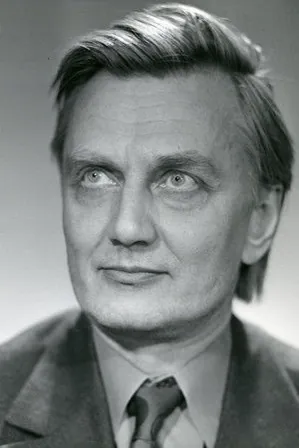
Viktors Lorencs, born in 1927 in Riga, was a Latvian actor known for his poignant performances. In Come and See (1985), he delivers a haunting portrayal that captures the devastation of war through the eyes of a child. His ability to convey deep emotional resonance in a harrowing narrative solidifies his significance in the realm of cult cinema. Lorencs' work transcends borders, offering a unique perspective on the human condition amidst chaos, making his contributions essential viewing on SassyFlix.
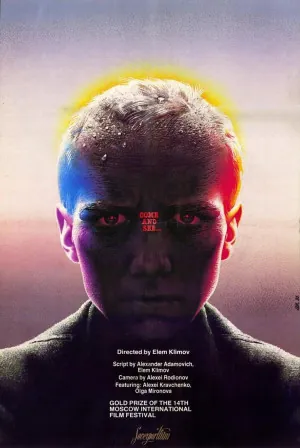
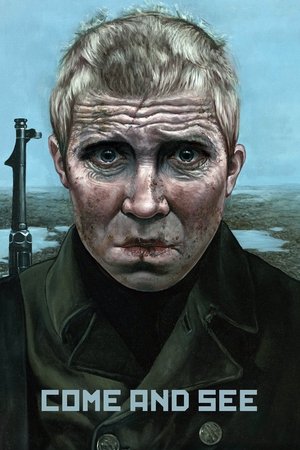
Come and See
In 1943, two Belarusian boys dig in a sand-filled trench looking for abandoned rifles in order to join the Soviet partisan forces. Their village elder warns them not to dig up the weapons as it would arouse the suspicions of the occupying Germans. One of the boys, Flyora, finds an SVT-40 rifle, though both of them are seen by an Fw 189 flying overhead. A Focke-Wulf Fw 189. A single reconnaissance aircraft of this model repeatedly appears in scenes flying above Flyora's head throughout Come and See. The next day two partisans arrive at Flyora's house, to conscript him. Flyora becomes a low-rank militiaman and is ordered to perform menial tasks. When the partisans are ready to move on, the partisan commander, Kosach, says that Flyora is to remain behind at the camp. Bitterly disappointed, Flyora walks into the forest weeping and meets Glasha, a young girl working as a nurse in the camp, and the two bond before the camp is suddenly attacked by German paratroopers and dive bombers. Flyora is partially deafened from the explosions before the two hide in the forest to avoid the German soldiers. Flyora and Glasha travel to his village, only to find his home deserted and covered in flies. Denying that his family is dead, Flyora believes that they are hiding on a nearby island across a bog. As they run from the village in the direction of the bogland, Glasha glances across her shoulder, seeing a pile of executed villagers' bodies stacked behind a house, but does not alert Flyora. The two become hysterical after wading through the bog, where Glasha then screams at Flyora that his family is actually dead in the village. They are soon met by Rubezh, a partisan fighter, who takes them to a large group of villagers who have fled the Germans. Flyora sees the village elder, badly burnt by the Germans, who tells him that he witnessed his family's execution and that he should not have dug up the rifles. Flyora, hearing this, then attempts suicide out of guilt, but Glasha and the villagers save and comfort him. Rubezh takes Flyora and two other men to find food at a nearby warehouse, only to find it being guarded by German troops. During their retreat, the group unknowingly wanders through a minefield resulting in the deaths of the two companions. That evening Rubezh and Flyora sneak up to an occupied village and manage to steal a cow from a collaborating farmer. As they escape across an open field, Rubezh and the cow are shot and killed by a German machine gun. The next morning, Flyora attempts to steal a horse and cart but the owner catches him and instead of doing him harm, he helps hide Flyora's identity when SS troops approach. Flyora is taken to the village of Perekhody, where they hurriedly discuss a fake identity for him, while the SS unit (based on the Dirlewanger Brigade) accompanied by Ukrainian collaborators surround and occupy the village. Flyora tries to warn the townsfolk as they are being herded to their deaths, but is forced to join them inside a wooden church. Flyora and a young woman manage to escape, but the latter is dragged by her hair across the ground and into a truck to be gang raped. Flyora is forced to watch as several Molotov cocktails and grenades are thrown onto and within the church before it is further set ablaze with a flamethrower as other soldiers shoot into the building. A German officer points a gun to Flyora's head to pose for a picture before leaving him to slump to the ground as the soldiers leave. Flyora later wanders out of the scorched village in the direction of the Germans, where he discovers they had been ambushed by the partisans. After recovering his jacket and rifle, Flyora comes across Glasha in a fugue state and covered in blood after having been gang-raped and brutalized. Flyora returns to the village and finds that his fellow partisans have captured eleven of the Germans and their collaborators, including the commander, an SS-Sturmbannführer. While some of the captured men including the commander and main collaborator plead for their lives and deflect blame, a young fanatical officer, an Obersturmführer, is unapologetic and vows they will carry out their genocidal mission. Kosach makes the collaborator douse the Germans with a can of petrol brought there by Flyora, but the disgusted crowd shoots them all before they can be set on fire. As the partisans leave, Flyora notices a framed portrait of Adolf Hitler in a puddle and proceeds to shoot it numerous times. As he does so, a montage of clips from Hitler's life play in reverse, but when Hitler is shown as a baby on his mother's lap, Flyora stops shooting and cries. A title card informs: "628 Belorussian villages were destroyed, along with all their inhabitants" (alternate translation: "628 Belarusian villages were burnt to the ground with all their inhabitants"). Flyora rushes to rejoin his comrades, and they march through the birch woods as snow blankets the ground.