Robert Banks Stewart, born in 1931 in Scotland, was a prolific screenwriter whose work in Danger Route (1967) showcases his knack for weaving suspenseful narratives. Known for his contributions to British television, he transitioned into film with a sharp eye for character-driven plots. His writing in Danger Route reflects the gritty undertones of the 1960s, blending espionage with the cultural zeitgeist of the era. Stewart's ability to craft engaging stories has left a lasting impact on the cult film landscape.
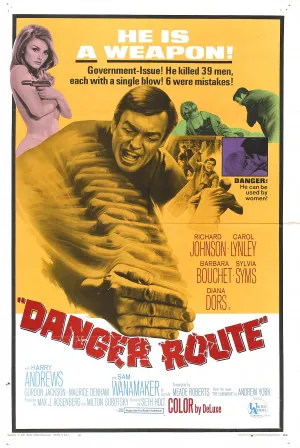
Danger Route
Jonas Wilde, a leading British secret agent/assassin returns home to the Channel Islands from a mission in the Caribbean fearing his nerve has gone, and attempts to resign. He is persuaded by his superior, Tony Canning, to undergo a final mission and assassinate a defector being held by the Americans. Wilde starts a relationship with Jocelyn. As part of the mission, Wilde seduces Rhoda, a housekeeper at the house where the scientist is being kept, in order to access the house. He is captured and interrogated by CIA agent Lucinda who tells Wilde that someone is causing British agents to be killed by mistake. Wilde escapes and goes looking for Canning, who has disappeared. He teams up with Canning's wife, Barbara, and heads to the base in the Channel Islands. A fellow agent, Brian Stern, tells him that another member of their unit, Peter Ravenspur, has been murdered. Wilde and Stern then take Ravenspur's niece Mari aboard Stern's boat for questioning. Stern reveals he is a double agent but is killed by Wilde. Mari, who has been working for Lucinda, is killed accidentally. Wilde goes back to London and discovers that his girlfriend, Jocelyn, was working for Stern. Wilde kills her. Canning tells Wilde that he is too valuable to be allowed to resign.