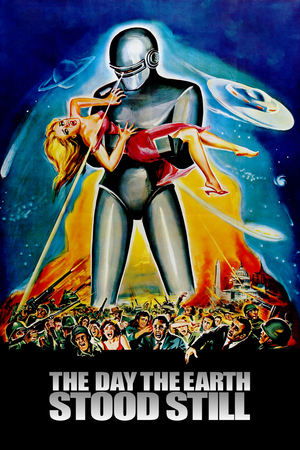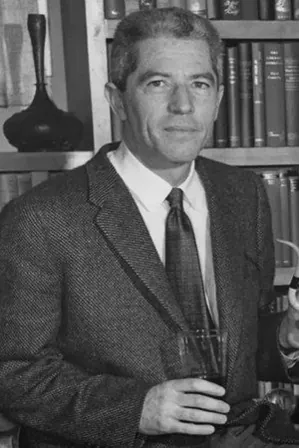
Edmund H. North, born in 1911, was a pivotal figure in American screenwriting, known for his work on The Day the Earth Stood Still (1951). His ability to blend science fiction with profound themes is exemplified in this classic, where he penned the iconic line, 'Klaatu barada nikto.' North's career began with plays during his time at Stanford University, and he later contributed to military training films during World War II. His legacy in cult cinema endures, showcasing the impact of his storytelling in shaping genre narratives.
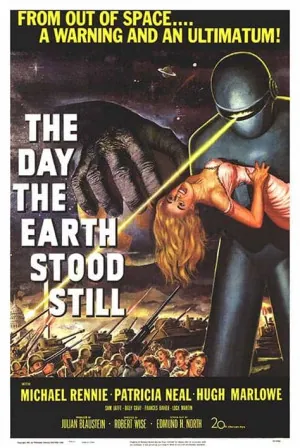
The Day the Earth Stood Still
When a flying saucer lands in Washington, D.C., the U.S. Army quickly surrounds it. A humanoid emerges and announces that he comes "in peace and with good will". When he unexpectedly opens a small device, he is shot and wounded by a nervous soldier. A tall robot emerges from the saucer and quickly disintegrates the Army's weapons. The alien orders the robot, Gort, to desist. He explains that the now-broken device was a gift for the President of the United States that would have enabled him "to study life on the other planets". The alien, Klaatu, is taken to Walter Reed Hospital. After surgery, he uses a salve to quickly heal his wound. Meanwhile, the Army tries but is unable to enter the saucer; Gort stands outside, silent and unmoving. Klaatu tells the President's secretary, Mr. Harley, he has a message that must be delivered to all the world's leaders simultaneously. Harley tells him that in the current political climate this is impossible. Klaatu suggests that he be allowed to go among humans to better understand their "unreasoning suspicions and attitudes". Harley rejects the proposal, and Klaatu remains under guard. Klaatu escapes to a boarding house as "Mr. Carpenter", the name ("Maj. Carpenter") on the dry cleaner's tag on a suit he acquired. Among the residents are young widow Helen Benson and her son Bobby. When Helen and her boyfriend Tom Stevens go out, Klaatu babysits Bobby. The boy takes Klaatu on a tour of the city, including a visit to his father's grave in Arlington National Cemetery; Klaatu learns that most of the deceased are soldiers killed in wars. They also visit the Lincoln Memorial. Klaatu asks Bobby who the greatest living person is; Bobby suggests Professor Barnhardt. Bobby takes Klaatu to Barnhardt's home, but the professor is out. Klaatu writes an equation on a blackboard to assist Barnhardt with a celestial mechanics problem; he leaves his contact information with the suspicious housekeeper. That evening, a government agent accompanies Klaatu to Barnhardt. Klaatu explains that the people of other planets are concerned now that humanity has developed rockets and a rudimentary form of atomic power. Klaatu declares that if his message is ignored, Earth will be "eliminated". Barnhardt agrees to gather scientists from around the world at the saucer; he then suggests Klaatu give a harmless demonstration of his power. Klaatu returns to his spaceship, unaware Bobby has followed him. Bobby sees Gort render two soldiers unconscious and Klaatu enter the saucer. Bobby tells Helen and Tom what he saw, but they do not believe him until Tom takes a diamond he found in Klaatu's room to a jeweler and learns it is "unlike any other on Earth". Klaatu finds Helen at her workplace, and they take an empty service elevator which stops precisely at noon. To demonstrate his power, Klaatu has temporarily neutralized all electricity everywhere on Earth, except for essential services such as hospitals and airplanes in flight. Klaatu reveals his true identity to Helen and asks for her help. Helen and Klaatu decide to visit Barnhardt. On the way, he tells her that should anything happen to him she must say to Gort, "Klaatu barada nikto." Their taxi is spotted and hemmed in. Klaatu is shot dead, and Helen rushes to the saucer. Hearing Klaatu's words, Gort carries Helen inside, retrieves Klaatu's body, and revives him. Klaatu explains to Helen that his revival is only temporary. Klaatu addresses Barnhardt's assembled scientists: an interplanetary organization has created a police force of invincible robots like Gort. "In matters of aggression, we have given them absolute power over us." Klaatu concludes, "Your choice is simple: join us and live in peace, or pursue your present course and face obliteration. We shall be waiting for your answer." Klaatu and Gort depart in the saucer. An alien (Klaatu) with his mighty robot (Gort) land their spacecraft on Cold War-era Earth just after the end of World War II. They bring an important message to the planet that Klaatu wishes to tell to representatives of all nations. However, communication turns out to be difficult, so, after learning something about the natives, Klaatu decides on an alternative approach.