Mario Morra, born in 1935 in Rome, is a notable Italian director and writer whose work spans various genres, including documentaries and mondo films. He is best known for his role as both director and writer of Savage Man Savage Beast (1975), a film that exemplifies the provocative nature of exploitation cinema. Morra's career began in the early 1960s as an assistant editor, and he later established himself as a significant figure in the Italian film industry, contributing to both art films and more sensational works.
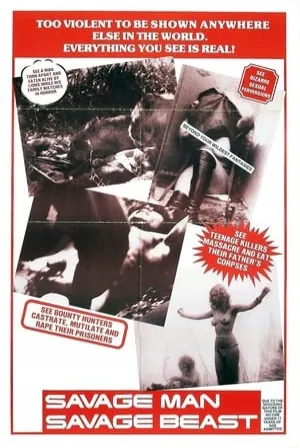
Savage Man Savage Beast
The film is a depiction of various scenes, usually violent or bizarre, that somehow relate to hunting. Each scenario is presented one after the other with little regard for narrative continuity. The opening scene introduces a Patagonian hunter who hunts stags to survive. The opening credits play over as he chases after a stag, which he ultimately shoots, kills, and beheads. Afterwards, one of the numerous scenes of anti-hunting gatherings is shown, this one in Cape Cod. The attention quickly shifts to wildlife hunting, where a monkey is killed by a leopard, and then a squirrel monkey by an anaconda. The theme changes again to the social hunt of wild game in Australia and Africa. Aborigines hunt kangaroos and other large marsupials with spears and giant bats with boomerangs. Indigenous tribes of Africa hunt large game, including antelope, buffalo, and elephants, in the savanna. Religious ceremonies are also shown, where the African hunters proceed to suck fresh blood from the entrails of an antelope, and the Australian aborigines symbolically bury their prey in dust to placate the spirits of the animals. Lastly, two brothers are arrested after partaking in a form of ritual post-mortem cannibalism of three of their relatives to acquire the hunting skills of the dead. Other hunting traditions then follow, again rooted in religion. The warriors of the Kuru tribe in Africa commit a sacred act in which they copulate with the ground in belief that it will make the Earth fertile and produce animals for the hunt, and a stag hunt in France, rooted in ancient pagan beliefs of the Gauls, is blessed by a mass before the hunt takes place, during which the hunters and dogs chase and ultimately kill a fleeing stag. In a fox hunt, the Wild Fox Association sabotages the hunting efforts by serving wine laced with a laxative to the hunters and distracting the dogs with an Afghan hound in heat. Their efforts are then connected to species conservation, and to exemplify that hunters are truly concerned in wildlife conservation, Argentine hunters capture an Andean condor to sell to a zoo. A collage of other conservation efforts is shown, including the tagging of white rhinoceroses, grizzly bears and elephants, which are shot with morphine darts. Argentinian deer and elephant seals are physically subdued and marked. Tourists on Africans safaris then come to view the conservation efforts, which the narrator claims to have seemingly negated the animals' violent instincts. This deception is demonstrated with the mauling of a tourist named Pit Dernitz by lions. Another anti-hunting demonstration becomes the film's focus, this time on the Isle of Wight. Nudity and intercourse are practiced freely amongst the demonstrators, and this is contrasted with ancient hunter-gathering groups, who had strict rules concerning nudity. The narrator argues that once hunting had left this group of people, so did their rules toward nudity. Also highlighted is the contradiction that though this people are against hunting, thousands of farm-raised animals had to die to support them. The focus changes to Humboldt penguins, which cannot hunt because of polluted waters, and thus seem detached and without focus. This effect is compared to modern day Eskimos, who no longer hunt since the discovery of oil in their homeland and have fallen into depression and melancholy. To reverse the process, several groups of men go out and revive their hunting ways. Reflected in this is a montage of gun ownership, which the film relates to feelings of masculinity, followed by shots of illegal elephant poaching from Africa. To offset the dwindling number of game due to poaching, warriors from the Lobi tribe celebrate the "Ceremony of Life", in which they masturbate with ceremonial rods and pour the product into the river, hoping the animals will drink the semen and multiply. Attention shifts to large electronic probes in the Peruvian savanna used to measure the winds of El Niño for optimal fishing conditions. Fishing birds are also electronically tagged so the prime fishing areas can be located based on the birds' fishing habits. This fish frenzy in South America is reflected in the salmon run in Alaska, where kodiak bears hunt and fight for prey. An examination of a hunting tradition in northern Europe follows, where falcons assist humans in hunting by catching wild game, such as rabbits and pheasants. Further collaboration with man and animal is highlighted, this time with cheetahs. To demonstrate the cheetah's speed and effectiveness, a chase between a group of cheetahs and ostriches is arranged, in which the birds are hunted down and killed. The next animal collaborators are dogs, which hunt wild boar in Patagonia and a puma which has attacked a herd of sheep and a shepherd. In cities, however, stray dogs are the ones hunted by dog catchers, which the narrator claims demonstrates that the hunt is still active, but the prey has changed. Indios also use dogs to hunt monkeys, but their efforts are compared to mercenaries hunting the Indios themselves to clear them from their native land for development. In one such instance, mercenaries retaliate against a death of a workman by hunting down a group of Indios, one of which they torture, castrate and murder. Various scenes of wildlife are then shown, after which orangutans are hunted to be sold to zoos. The film then ends with the coexistence of man and animal between Erik Zimen, an ecologist, and wolves, the group of animals he wishes to save.